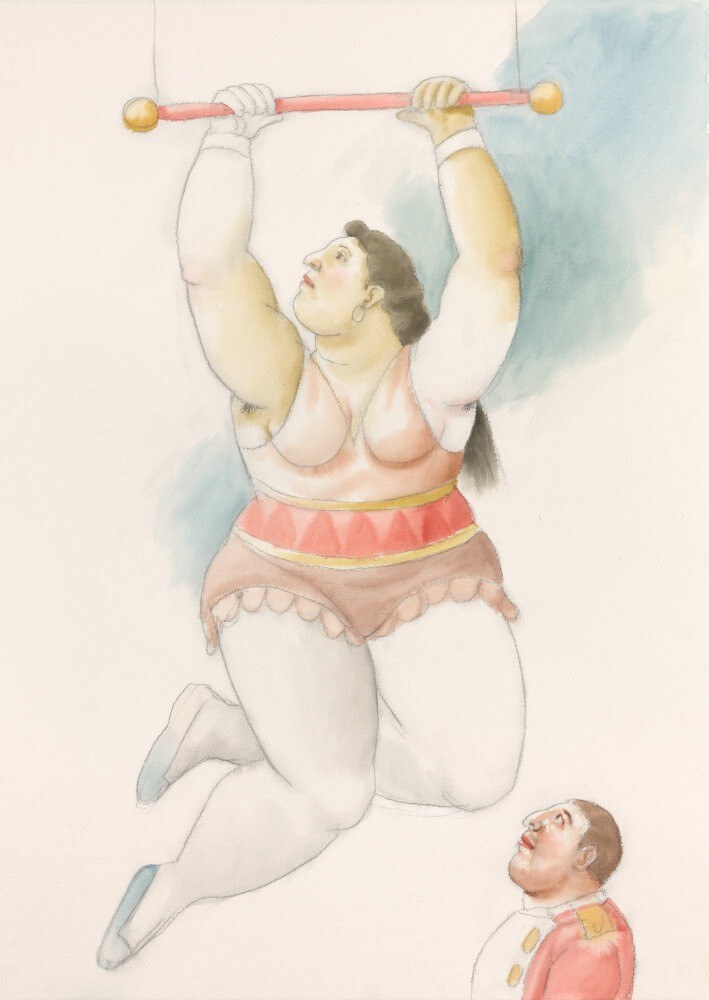
La figura dell'acrobata è rappresentata nel momento in cui rimane sospesa alla sbarra, trattenuta dalle mani in una posizione che interrompe ogni percezione di gravità senza rinunciare alla consistenza fisica del corpo. Le braccia, completamente distese sopra il capo, costituiscono il principale asse della composizione e conducono lo sguardo verso l'elemento orizzontale della sbarra, che delimita superiormente l'immagine e diviene il punto di massima tensione dell'intero impianto. Al di sotto, il corpo si raccoglie in una successione continua di superfici morbide; il busto, il bacino e le gambe mantengono una compattezza volumetrica che sembra appartenere alla stabilità della figura stante più che alla leggerezza dell'esercizio acrobatico. Una gamba rimane distesa verso il basso, mentre l'altra si piega all'indietro, introducendo l'unica significativa variazione ritmica all'interno della costruzione. In basso, appena oltre il margine inferiore della figura principale, compare il volto di un clown che rivolge lo sguardo verso l'acrobata; la sua presenza, volutamente ridotta, contribuisce a stabilire la scala della rappresentazione senza alterare la centralità assoluta della protagonista. Il fondo, risolto attraverso leggere velature azzurre distribuite intorno alla figura, rinuncia a qualsiasi definizione dello spazio circense e lascia che il bianco della carta partecipi direttamente alla costruzione luminosa dell'immagine.
L'interesse dell'opera risiede nella tensione instaurata fra il principio della sospensione e la saldezza plastica del corpo. L'acrobata è raffigurata durante un esercizio che presuppone equilibrio, leggerezza e continuo controllo del movimento; tuttavia Botero evita qualsiasi accentuazione dinamica e costruisce la figura attraverso una misura che restituisce al corpo una qualità di stabile permanenza. La sospensione non viene quindi affidata all'enfasi del gesto, ma alla semplice relazione fra il corpo e la sbarra, mentre il volume conserva una compattezza che sembra sottrarsi alle leggi della gravità. Da questa apparente contraddizione nasce una delle immagini più originali dell'intera serie circense, nella quale il movimento non dissolve la massa, ma la rende ancora più evidente.
Anche il costume partecipa direttamente a questa costruzione figurativa. Il corpetto, la breve gonna decorata e le calze accompagnano la progressione anatomica senza interromperne la continuità, mentre la fascia rossa che attraversa la vita stabilisce una cesura cromatica capace di scandire il passaggio fra il torso e gli arti inferiori. La decorazione rimane costantemente subordinata all'organizzazione del volume; ogni variazione cromatica segue infatti l'espansione delle superfici e contribuisce a rendere leggibile l'articolazione del corpo senza mai trasformarsi in puro ornamento. Anche la sbarra, dipinta con un rosso intenso che trova corrispondenza nella fascia del costume, entra a far parte di questa organizzazione, costituendo un elemento di equilibrio cromatico prima ancora che narrativo.
La tecnica dell'acquerello rende particolarmente evidente il procedimento esecutivo adottato dall'artista. Il ductus del disegno governa con assoluta sicurezza il profilo della figura e definisce la continuità delle grandi superfici, mentre le velature cromatiche si depositano con estrema trasparenza, lasciando costantemente emergere la luminosità del supporto cartaceo. Il modellato evita qualsiasi accentuazione chiaroscurale e si sviluppa attraverso progressive modulazioni tonali che accompagnano naturalmente l'espansione dei volumi. Ne deriva una pittura nella quale la leggerezza del mezzo non attenua la presenza fisica della figura, ma contribuisce a renderla ancora più intensa attraverso una straordinaria economia di mezzi espressivi.
Il ciclo del circo rappresenta uno dei momenti più alti della riflessione figurativa di Fernando Botero, poiché gli consente di confrontarsi con corpi sottoposti a condizioni estreme di equilibrio, tensione e movimento. In questa Donna del circo, tuttavia, l'artista evita ogni spettacolarizzazione dell'esercizio acrobatico; ciò che lo interessa non è la descrizione dell'impresa, ma la possibilità di verificare come una figura sospesa possa conservare la stessa solidità plastica di una figura immobile. L'acrobata diviene così il luogo nel quale peso e leggerezza, stabilità e movimento, monumentalità e sospensione cessano di essere termini opposti e trovano una sintesi di straordinaria coerenza formale, affidata esclusivamente alla disciplina del disegno, alla misura del colore e all'equilibrio della costruzione pittorica.
The acrobat is depicted at the moment in which she hangs suspended from the horizontal bar, her body supported entirely by her hands in a pose that negates the force of gravity without diminishing the physical solidity of her form. Her arms, fully extended above her head, establish the principal vertical axis of the composition and guide the viewer's gaze towards the bar, whose horizontal line defines the upper limit of the image while simultaneously becoming the point of greatest structural tension within the pictorial field. Beneath this anchoring element, the body unfolds through a continuous succession of broad, rounded surfaces; the torso, pelvis, and legs preserve a compact volumetric coherence more readily associated with the stability of a standing figure than with the lightness ordinarily expected of an aerial performance. One leg descends vertically towards the lower edge of the sheet, while the other bends gently backwards, introducing the only significant rhythmic variation within an otherwise remarkably measured construction. At the lower margin of the composition, the head of a clown appears just beyond the acrobat's body, his gaze directed upwards towards the performer; his deliberately reduced scale establishes a perceptual measure for the scene without compromising the absolute centrality of the principal figure. The background, articulated through delicate blue washes surrounding the body, relinquishes every reference to the physical environment of the circus and allows the white of the paper to participate directly in the luminous organisation of the composition.
The particular originality of the work resides in the tension established between suspension and corporeal weight. The acrobat performs an exercise that presupposes balance, lightness, and uninterrupted control of movement; Botero, however, deliberately suppresses every dramatic accent associated with physical exertion, constructing the figure according to a measured formal order that restores to the body a condition of stable permanence. Suspension is therefore entrusted not to the theatricality of gesture but to the simple relationship established between the body and the bar, while the volumes preserve a compact consistency that appears almost independent of the laws of gravity. It is precisely from this apparent contradiction that one of the most compelling images of the circus cycle emerges, for movement does not dissolve mass but instead renders its constructive presence even more evident.
The costume participates fully in this figurative organisation. The bodice, the short decorated skirt, and the stockings accompany the anatomical development of the figure without interrupting its continuity, while the red sash encircling the waist establishes a chromatic articulation that marks the transition between the torso and the lower limbs. Decorative elements remain consistently subordinated to the structural organisation of the body; each chromatic variation follows the expansion of the surfaces and contributes to the legibility of the figure without ever becoming ornamental for its own sake. The horizontal bar itself, painted in a vivid red that finds its chromatic counterpart in the sash, becomes an integral component of the compositional order, functioning as a principle of visual equilibrium before assuming any narrative significance.
The watercolour technique renders Botero's pictorial procedure particularly transparent. The linear ductus governs the contours of the figure with complete assurance, defining the continuity of the broad surfaces through an economy of means characteristic of the artist's late practice. Transparent washes are superimposed with exceptional restraint, consistently allowing the luminosity of the paper support to remain active within the pictorial structure. Modelling avoids emphatic chiaroscuro and develops instead through gradual tonal transitions that accompany the expansion of volume with remarkable naturalness. The inherent lightness of the medium does not diminish the physical presence of the figure; on the contrary, it reinforces its plastic authority through a language of extraordinary technical refinement and expressive economy.
The circus cycle occupies a singular position within Fernando Botero's artistic production, providing the artist with an opportunity to explore bodies subjected to conditions of equilibrium, tension, and controlled movement. In this Circus Woman, however, the spectacle of the acrobatic feat is deliberately subordinated to a more profound pictorial inquiry. Botero's interest lies not in describing the performance itself but in demonstrating how a suspended body may retain the same plastic coherence and monumental stability as a figure firmly grounded upon the earth. The acrobat consequently becomes the locus in which weight and lightness, movement and permanence, monumentality and suspension cease to function as oppositional categories and are instead reconciled within a remarkably coherent formal synthesis, achieved entirely through the disciplined interaction of drawing, chromatic modulation, and compositional order.