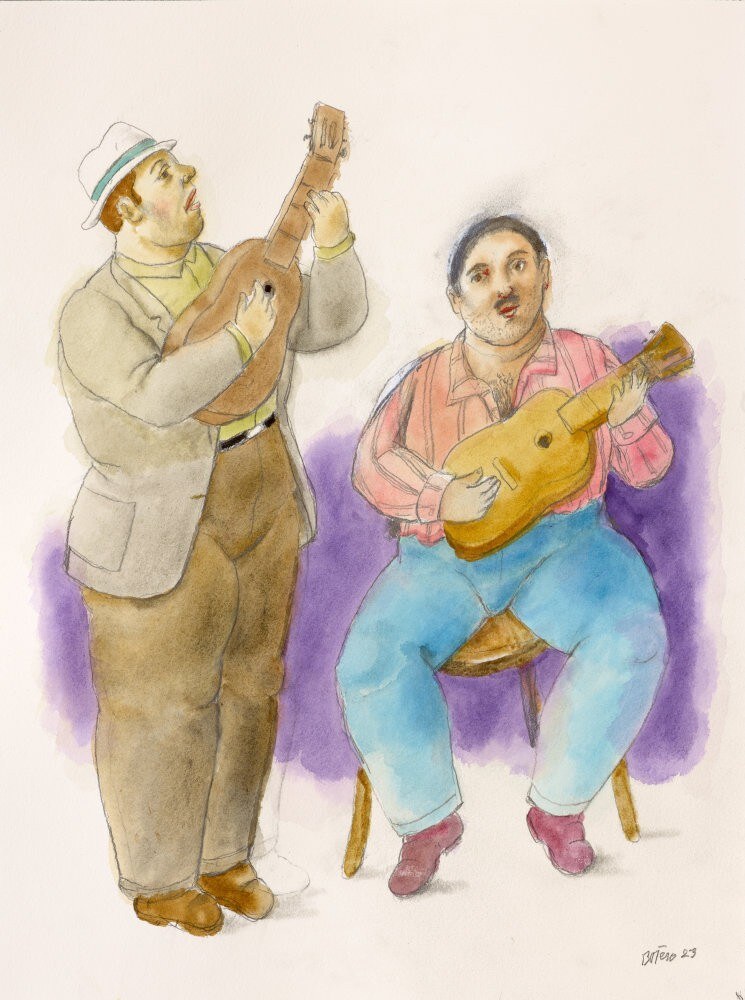
L'immagine si costruisce attorno al dialogo fra due musicisti, disposti secondo una soluzione compositiva che rinuncia a qualsiasi descrizione dell'ambiente per concentrare l'intero interesse sul rapporto instaurato fra le figure e gli strumenti. A sinistra, un contrabbassista, colto nell'atto di pizzicare le corde, sviluppa la propria presenza lungo un saldo asse verticale determinato dall'andamento dello strumento; sulla destra, un chitarrista seduto introduce un diverso principio ritmico, affidato alla posizione obliqua della chitarra, alla flessione delle gambe e alla più raccolta articolazione della figura. Fra i due si stabilisce un equilibrio di particolare sottigliezza, nel quale la diversa postura dei corpi e la differente natura degli strumenti generano una costruzione figurativa fondata sul reciproco bilanciamento delle masse piuttosto che sulla simmetria.
Il contrabbasso assume un ruolo strutturale di primaria importanza; la sua ampia sagoma prolunga la figura verso l'alto e costituisce il principale elemento ordinatore dell'intera composizione, mentre la chitarra, raccolta entro il perimetro del corpo del musicista seduto, concentra il peso visivo nella metà destra del foglio. I due strumenti, pur appartenendo alla medesima famiglia musicale, svolgono pertanto funzioni profondamente differenti all'interno dell'immagine; il primo organizza lo sviluppo verticale della composizione, il secondo introduce una più accentuata espansione orizzontale, generando un sistema di tensioni che conferisce all'insieme una misura di grande equilibrio. Anche la diversa collocazione delle figure contribuisce a tale risultato; il musicista in piedi imprime all'immagine una spinta ascensionale, mentre quello seduto stabilizza la composizione attraverso la propria compatta presenza volumetrica.
La relazione fra i due personaggi si sviluppa interamente sul piano della costruzione figurativa. Gli sguardi non cercano il contatto reciproco e ciascun musicista rimane raccolto nella propria esecuzione; la coesione dell'insieme nasce così dalla sintassi delle forme, dall'accordo fra i diversi assi compositivi e dalla continuità del ritmo visivo. La musica, pur costituendo il soggetto dichiarato dell'opera, rimane affidata esclusivamente alla qualità delle posture, all'inclinazione delle braccia e alla posizione degli strumenti, senza ricorrere a espedienti narrativi o a effetti descrittivi. L'azione viene ricondotta a una dimensione di assoluta essenzialità, entro la quale il gesto musicale coincide con la misura stessa della composizione.
La tecnica dell'acquerello rende particolarmente evidente il procedimento costruttivo adottato da Botero negli ultimi anni della sua attività. La linea mantiene una funzione ordinatrice di assoluta chiarezza, definendo con sicurezza il profilo delle figure e degli strumenti; le velature cromatiche intervengono con estrema economia, accompagnando la costruzione dei volumi attraverso leggere modulazioni tonali che lasciano costantemente affiorare il bianco della carta. Le campiture violacee disposte alle spalle dei musicisti non descrivono uno spazio reale, ma introducono un contrappunto cromatico che raccoglie le figure entro una medesima unità percettiva, evitando che esse si disperdano nella neutralità del fondo. La luminosità del supporto diviene così parte integrante della stesura pittorica e contribuisce alla definizione dell'equilibrio complessivo dell'immagine.
L'attenzione riservata agli strumenti rivela un aspetto significativo della riflessione figurativa di Botero. Contrabbasso e chitarra non costituiscono semplici attributi iconografici, ma si integrano pienamente nell'organismo compositivo, partecipando alla distribuzione delle masse e alla scansione ritmica della superficie. La loro presenza modifica direttamente la postura dei corpi, determina l'orientamento delle braccia e organizza il sistema delle linee portanti; ne deriva una costruzione nella quale figura e oggetto condividono la medesima funzione strutturale, fino a costituire un'unica articolazione formale.
Questo piccolo acquerello, eseguito nell'ultimo anno di vita dell'artista, testimonia la straordinaria capacità di Fernando Botero di ricondurre un soggetto tradizionale entro una sintesi figurativa di rara maturità. La riduzione dei mezzi espressivi coincide con una crescente precisione della costruzione; il disegno governa l'intero assetto dell'immagine, il colore interviene come principio di modulazione luminosa e la composizione raggiunge un equilibrio nel quale ogni elemento appare necessario. La scena musicale cessa così di appartenere al dominio dell'episodio e si afferma come una meditazione sul ritmo, sulla relazione fra le forme e sulla capacità della pittura di trasformare il suono in una struttura interamente visiva.
The composition is organised around the dialogue established between two musicians, arranged according to a pictorial solution that deliberately relinquishes every descriptive reference to the surrounding environment in order to concentrate entirely upon the relationship between the figures and their instruments. At the left, a double bassist, captured in the act of plucking the strings, develops his presence along the firm vertical axis established by the instrument itself; to the right, a seated guitarist introduces a different rhythmic principle through the oblique placement of the guitar, the flexion of the legs, and the more compact articulation of the body. Between the two figures a remarkably subtle equilibrium emerges, in which the differing postures and the distinct physical character of the instruments generate a figurative construction founded upon the reciprocal calibration of the masses rather than upon any strict compositional symmetry.
The double bass assumes a primary structural role within the composition. Its elongated silhouette extends the figure vertically and establishes the principal ordering axis of the image, whereas the guitar, contained within the perimeter of the seated musician's body, concentrates the visual weight in the right half of the sheet. Although both belong to the same family of musical instruments, they fulfil profoundly different constructive functions within the pictorial economy; the former governs the vertical development of the composition, while the latter introduces a more pronounced horizontal articulation, creating a system of formal tensions that confers exceptional balance upon the whole. The differing positions of the two musicians contribute decisively to this equilibrium: the standing figure imparts an ascending impulse to the composition, whereas the seated musician stabilises it through the compact coherence of his volumetric presence.
The relationship between the two performers unfolds entirely within the language of figurative construction. Their gazes do not seek one another, and each musician remains absorbed in the discipline of performance; the coherence of the image therefore arises through the syntax of forms, the measured correspondence of the principal compositional axes, and the continuity of visual rhythm. Music, although constituting the declared subject of the work, is entrusted exclusively to the articulation of posture, the inclination of the arms, and the disposition of the instruments, without recourse to anecdotal devices or descriptive emphasis. The act of performance is thus reduced to its essential condition, where musical execution becomes inseparable from the measured order of the composition itself.
The watercolour technique renders particularly legible the constructive procedure adopted by Botero during the final years of his career. Line retains a function of remarkable structural authority, defining with exceptional assurance the contours of both figures and instruments; transparent washes intervene with great economy, accompanying the formation of volume through delicate tonal modulations that consistently allow the white of the paper to participate in the luminous organisation of the image. The violet washes placed behind the musicians do not describe a physical setting but establish a chromatic counterpoint that gathers the figures into a unified perceptual field, preventing them from dissolving into the neutrality of the background. The luminosity of the support thus becomes an active component of the pictorial process, contributing directly to the overall equilibrium of the composition.
The attention devoted to the musical instruments reveals a significant aspect of Botero's figurative thought. The double bass and the guitar do not function as simple iconographic attributes but become fully integrated into the compositional organism, participating in the distribution of the masses and in the rhythmic articulation of the pictorial surface. Their presence directly determines the posture of the bodies, governs the orientation of the arms, and establishes the principal structural lines of the composition; figure and instrument consequently share an identical constructive function, becoming inseparable components of a single formal organisation.
Executed during the final year of the artist's life, this small watercolour bears eloquent witness to Fernando Botero's extraordinary ability to condense a traditional subject into a figurative synthesis of exceptional maturity. The reduction of expressive means corresponds to an increasing precision of formal construction; drawing governs the entire structural order of the image, colour intervenes as an instrument of luminous modulation, and the composition achieves an equilibrium in which every element appears indispensable. The musical scene thereby transcends the realm of anecdotal representation and becomes a meditation upon rhythm, the reciprocity of forms, and the enduring capacity of painting to translate the experience of sound into an entirely visual order.