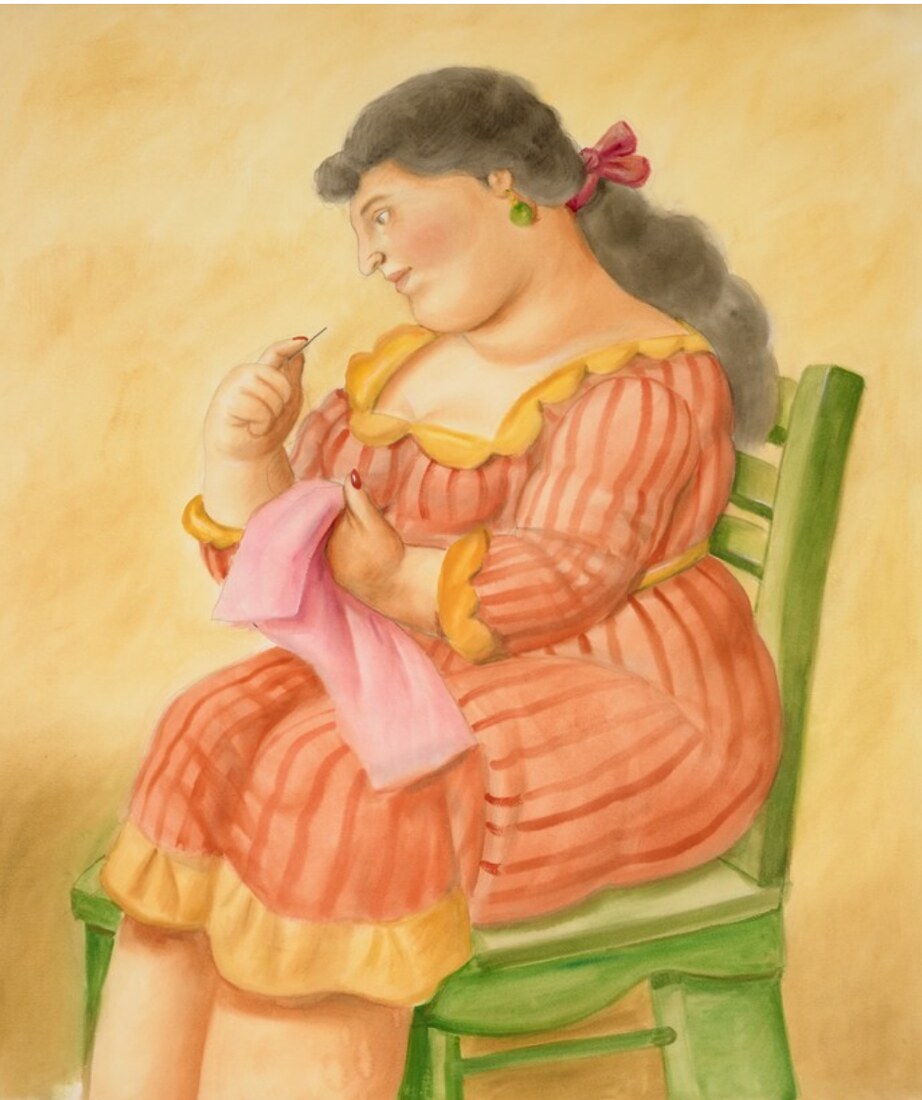
Una donna è raffigurata mentre cuce, seduta con il corpo leggermente inclinato in avanti e lo sguardo rivolto verso il ricamo che sostiene fra le mani. L'intera costruzione della figura nasce da questo gesto raccolto, che determina l'orientamento del capo, la posizione delle braccia e il naturale piegarsi del busto. L'abito, caratterizzato da una regolare successione di bande verticali azzurre e bianche, avvolge il corpo con ampiezza continua, sviluppandosi dalle spalle fino ai piedi senza alterare la compattezza della figura; il colletto e i polsini, definiti dalle balze gialle, introducono una variazione cromatica misurata che interrompe il ritmo delle righe senza modificarne l'ordine. I capelli, raccolti da un nastro rosso, incorniciano il volto e ne accompagnano il profilo, mentre la sedia rimane quasi interamente assorbita dalla presenza della figura, limitandosi a sostenerne la postura. Il fondo, costruito mediante una campitura uniforme di colore caldo, rinuncia a qualsiasi definizione dell'ambiente e concentra l'attenzione esclusivamente sulla relazione fra il corpo, il gesto e la superficie pittorica.
L'interesse dell'opera si sviluppa intorno alla misura con cui Botero organizza il rapporto fra immobilità e azione. Il cucire introduce infatti un movimento minimo, affidato quasi esclusivamente al dialogo delle mani con il tessuto, mentre il resto della figura mantiene una condizione di assoluta stabilità. Da questa apparente opposizione nasce il ritmo dell'intera composizione; il gesto, pur rimanendo estremamente contenuto, diviene il centro ordinatore dell'immagine e governa la distribuzione delle masse, la direzione dello sguardo e la successione delle principali linee di forza. L'azione perde così qualsiasi carattere descrittivo e viene progressivamente ricondotta entro una dimensione esclusivamente figurativa, nella quale il lavoro manuale assume il valore di principio costruttivo della rappresentazione.
In questa prospettiva l'abito svolge una funzione determinante. La sequenza regolare delle bande verticali accompagna il modellato del corpo e rende leggibile l'espansione dei volumi, seguendo con naturale continuità l'andamento delle spalle, del torace, del grembo e delle gambe. Il motivo decorativo cessa di appartenere alla semplice ornamentazione del tessuto e partecipa direttamente alla costruzione plastica della figura, poiché le righe si incurvano, si dilatano e si comprimono secondo l'articolazione delle superfici, rendendo percepibile la presenza del corpo senza ricorrere a una definizione analitica dell'anatomia. Anche il piccolo ricamo, raccolto fra le mani, assume una funzione che supera il proprio significato descrittivo; esso rappresenta il punto nel quale convergono gli assi principali della composizione e dal quale lo sguardo riprende il proprio percorso lungo la continuità della veste.
La tecnica dell'acquerello rivela con particolare chiarezza il procedimento esecutivo dell'artista. Il disegno mantiene una funzione strutturale rigorosa, definendo con precisione il profilo della figura e regolando l'intero assetto compositivo; il colore interviene attraverso velature trasparenti, distribuite con estrema economia, che costruiscono il modellato mediante leggere modulazioni tonali senza compromettere la luminosità del supporto cartaceo. La carta rimane costantemente percepibile e partecipa attivamente alla definizione della luce, mentre la materia pittorica conserva quella trasparenza che costituisce una delle qualità più caratteristiche degli acquerelli di Botero. Disegno e colore operano così secondo un principio di perfetta complementarità, nel quale la solidità della costruzione plastica nasce dalla massima semplicità dei mezzi espressivi.
La figura della donna che cuce appartiene a un tema profondamente radicato nella storia della pittura occidentale, frequentemente associato alla rappresentazione della dimensione domestica e del lavoro silenzioso. Fernando Botero si misura con questa tradizione evitando ogni intento narrativo o sentimentale; il soggetto conserva la propria immediata riconoscibilità, ma il suo significato si trasferisce progressivamente dalla descrizione dell'attività alla qualità della costruzione figurativa. L'opera diviene così una riflessione sulla continuità della forma, sull'equilibrio dei rapporti proporzionali e sulla capacità della pittura di trasformare un gesto quotidiano in un'immagine di stabile permanenza. In questa sintesi fra disciplina compositiva, controllo del ritmo lineare e sobrietà cromatica si riconosce uno degli esiti più maturi della ricerca di Botero nell'ambito dell'acquerello, dove la riduzione dei mezzi espressivi coincide con un progressivo approfondimento della qualità formale.
A woman is depicted seated while engaged in sewing, her body inclined gently forward and her gaze absorbed by the embroidery held between her hands. The entire organisation of the figure originates in this restrained gesture, which determines the inclination of the head, the disposition of the arms, and the natural inflection of the torso. The ample dress, articulated through a regular succession of vertical blue and white stripes, envelops the body in a continuous sequence of broad surfaces extending from the shoulders to the feet without disrupting the compactness of the figure; the yellow ruffles of the collar and cuffs introduce measured chromatic accents that punctuate the rhythmic order of the garment without altering its structural coherence. The dark hair, gathered by a red ribbon, frames the face and prolongs the profile of the head with understated continuity, while the chair remains almost entirely absorbed into the composition, serving solely to sustain the posture. The background, resolved through a uniform field of warm colour, relinquishes every descriptive reference to setting and directs the viewer's attention exclusively towards the relationship between the body, the act of sewing, and the pictorial surface.
The work derives its particular intensity from the manner in which Botero organises the relationship between stillness and action. Sewing introduces only the slightest movement, entrusted almost entirely to the measured dialogue between the hands and the fabric, while the remainder of the figure preserves an extraordinary composure. From this apparent opposition emerges the rhythm governing the entire composition; the gesture, though deliberately restrained, becomes the ordering principle of the image, regulating the distribution of the masses, the orientation of the gaze, and the articulation of its principal structural axes. The action consequently relinquishes every anecdotal implication and is progressively transformed into a purely pictorial device through which the formal coherence of the composition is established. The quiet concentration of the figure is therefore expressed not through psychological characterisation but through the measured discipline of the compositional order itself.
Within this context, the garment assumes a decisive constructive function. The regular sequence of vertical bands accompanies the modelling of the body, rendering the expansion of the volumes fully legible while following with uninterrupted continuity the development of the shoulders, torso, lap, and legs. The decorative motif thereby ceases to function merely as the ornamentation of a textile surface and becomes an active component of the plastic organisation of the figure; the stripes bend, expand, and contract in accordance with the articulation of the underlying forms, making the physical presence of the body perceptible without recourse to analytical anatomical description. Even the small piece of embroidery held between the hands transcends its descriptive role, functioning instead as the compositional focus in which the principal structural directions converge before guiding the eye back across the uninterrupted rhythm of the dress.
The handling of watercolour reveals with exceptional clarity the artist's pictorial procedure. Drawing retains complete structural authority, defining the contours of the figure with precision and regulating the compositional equilibrium of the entire sheet; colour is introduced through transparent washes of remarkable economy, constructing volume by means of subtle tonal modulations while preserving the luminosity of the paper support. The paper itself remains constantly active within the pictorial process, participating directly in the organisation of light, while the pigment preserves the transparency that characterises Botero's finest works in watercolour. Drawing and colour consequently operate in perfect reciprocity, the former establishing the architectural order of the image, the latter articulating its plastic consistency through an exceptionally restrained chromatic vocabulary.
The figure of the woman sewing belongs to a subject deeply rooted in the history of Western painting, traditionally associated with the representation of domestic life and the quiet dignity of manual labour. Botero approaches this enduring theme without narrative intention or sentimental emphasis; the subject remains immediately recognisable, yet its significance gradually shifts from the description of an activity to the internal logic of pictorial construction. The image thus becomes a reflection upon the continuity of form, the equilibrium of proportional relationships, and the capacity of painting to transform an ordinary gesture into an image of enduring permanence. In this convergence of compositional discipline, measured linear rhythm, and chromatic restraint resides one of the most accomplished achievements of Botero's work in watercolour, where the progressive reduction of expressive means corresponds to an ever more profound concentration upon the essential principles of figurative construction.