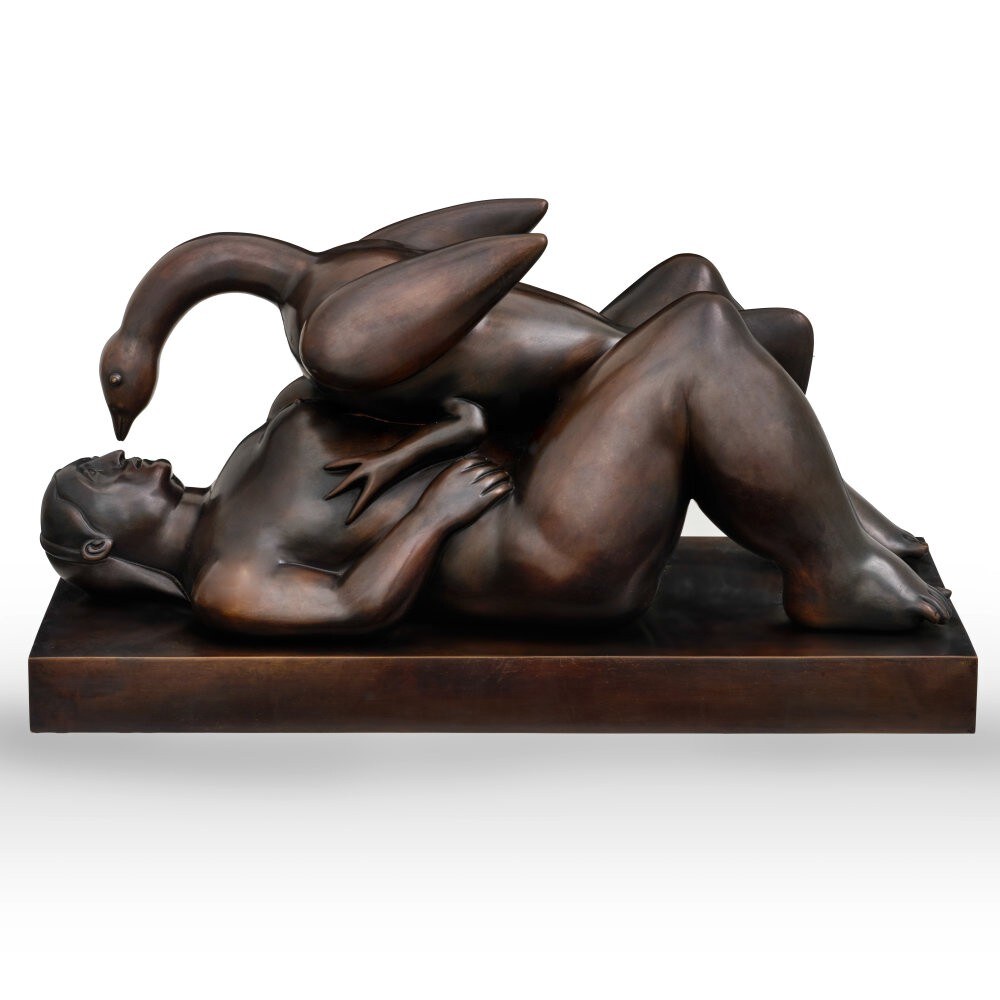
Fra i soggetti appartenenti al patrimonio iconografico della classicità, Leda e il cigno occupa una posizione del tutto particolare, poiché riassume entro un'unica immagine alcune delle questioni fondamentali che hanno attraversato la storia della rappresentazione occidentale, dalla riflessione sul mito alla costruzione del nudo, dal tema della metamorfosi al rapporto fra umano e divino. Poche invenzioni figurative hanno conosciuto una fortuna tanto duratura, alimentando, nel corso dei secoli, interpretazioni profondamente differenti e offrendo agli artisti un terreno privilegiato sul quale misurare la propria idea di bellezza, di natura e di forma. Nel confrontarsi con questa tradizione, Fernando Botero sceglie una strada sorprendentemente autonoma. Il mito permane come memoria culturale, mentre il racconto perde progressivamente ogni centralità, lasciando emergere una riflessione che riguarda anzitutto la costruzione della scultura e la capacità della materia di trasformare un tema antico in una presenza assolutamente contemporanea.
La lunga vicenda figurativa di Leda e il cigno si è quasi sempre sviluppata attorno alla rappresentazione dell'evento. Dalla pittura vascolare greca ai rilievi romani, dalle invenzioni di Leonardo e Michelangelo fino alle celebri interpretazioni di Correggio, Tintoretto e Rubens, il momento dell'incontro fra la donna e il cigno è stato costantemente concepito come una narrazione, nella quale il gesto, lo sguardo e il movimento costruiscono la tensione dell'immagine. Anche quando il soggetto si libera delle implicazioni letterarie, permane la volontà di restituire la drammaticità dell'episodio, facendo dell'erotismo, della metamorfosi o dell'ambiguità psicologica il centro stesso della rappresentazione. La scultura di Botero si colloca al di fuori di questa tradizione interpretativa. L'episodio sopravvive soltanto nella riconoscibilità dell'iconografia, mentre la narrazione viene progressivamente assorbita dalla costruzione plastica, fino a lasciare che la forma divenga il luogo esclusivo nel quale l'opera trova la propria ragione.
Il rapporto fra Leda e il cigno si sviluppa secondo una logica che appartiene interamente alla scultura. I due corpi rinunciano a qualsiasi contrapposizione narrativa e partecipano della medesima costruzione volumetrica, condividendo una continuità che attenua progressivamente la distinzione fra figura umana e figura animale. Il cigno cessa di rappresentare una presenza estranea al corpo di Leda e viene assimilato entro il medesimo ordine costruttivo, contribuendo alla definizione di un organismo unitario nel quale ogni volume trova il proprio equilibrio nella relazione con quello adiacente. La composizione restituisce così una qualità di straordinaria coesione, facendo della continuità plastica il vero fondamento dell'immagine.
In questa prospettiva assume un significato nuovo anche il tema della metamorfosi. Nella cultura classica essa coincide con la trasformazione di Zeus nel cigno e costituisce il presupposto narrativo dell'intero episodio. Botero trasferisce il concetto di metamorfosi dal racconto alla materia. La trasformazione non appartiene più al soggetto, ma al comportamento stesso della forma, che sembra modificarsi lentamente attraverso il succedersi delle superfici, fino a rendere quasi impercettibile il confine fra le due presenze. La continuità del modellato suggerisce una lenta propagazione della materia nella quale il corpo della donna e quello dell'animale partecipano di una medesima crescita plastica. La metamorfosi si manifesta così come qualità intrinseca della costruzione scultorea, liberata da ogni necessità narrativa e ricondotta entro il linguaggio autonomo del volume.
Questa scelta rivela una profonda riflessione sul significato della classicità. L'opera evita qualsiasi riferimento archeologico, qualsiasi intenzione citazionistica e qualunque rapporto diretto con le celebri interpretazioni rinascimentali del soggetto. La memoria della tradizione continua ad abitare la scultura come un principio culturale sedimentato, riconoscibile nella permanenza dell'iconografia, mentre il linguaggio appartiene interamente alla sensibilità contemporanea dell'artista. La classicità emerge allora come metodo costruttivo, come ricerca dell'equilibrio, della misura e della chiarezza dell'impianto plastico, piuttosto che come recupero di modelli storici. Il dialogo con il passato si sviluppa attraverso la qualità della forma e non attraverso la ripresa delle sue immagini.
L'intera composizione si organizza attorno a un equilibrio che sembra sottrarsi a qualsiasi sviluppo temporale. Nulla suggerisce un momento preciso dell'azione, nessun elemento conduce lo sguardo verso ciò che è appena accaduto o verso ciò che accadrà. La figura esiste entro una dimensione sospesa, nella quale il tempo del mito viene lentamente sostituito dal tempo della scultura. L'immagine perde il carattere dell'avvenimento e acquisisce quello della permanenza, trasformando un episodio della tradizione classica in una presenza che sembra appartenere a una durata assoluta. È proprio questa sospensione temporale a conferire all'opera una particolare intensità contemplativa, affidando alla forma il compito di custodire ciò che il racconto aveva tradizionalmente espresso attraverso l'azione.
La superficie accompagna questa costruzione con una straordinaria sensibilità. Il modellato procede attraverso passaggi ampi e continui, lasciando che la luce percorra il bronzo senza incontrare brusche cesure. Ogni variazione luminosa contribuisce a rendere leggibile il lento sviluppo delle masse, mentre la patina restituisce alla materia una morbidezza inattesa, capace di attenuare la naturale durezza del metallo. La luce non definisce semplicemente i volumi, ma partecipa attivamente alla costruzione della loro continuità percettiva, facendo emergere una qualità organica che accompagna l'intera composizione.
Di particolare interesse appare anche il rapporto fra i pieni e gli spazi che si generano fra le due figure. La scultura evita qualsiasi effetto di sovrapposizione o di semplice accostamento, costruendo invece una sequenza di raccordi che rende il vuoto parte integrante dell'organismo plastico. Lo spazio penetra nella composizione con la stessa naturalezza della materia, contribuendo a determinare il ritmo dell'opera e rendendo percepibile l'unità dell'insieme attraverso la reciproca dipendenza di tutte le sue componenti. La forma si costruisce tanto attraverso ciò che occupa quanto attraverso ciò che lascia libero, secondo un principio che appartiene alle più alte esperienze della scultura moderna.
Osservata nel contesto della produzione plastica di Fernando Botero, Leda e il cigno rappresenta uno dei momenti più alti della sua riflessione sul rapporto fra memoria della tradizione e autonomia del linguaggio contemporaneo. Il mito, liberato dalla dimensione narrativa, diviene il luogo nel quale la scultura interroga se stessa, la propria capacità di trasformare un tema antico in una costruzione governata esclusivamente dalla misura, dall'equilibrio e dalla continuità della forma. La permanenza dell'immagine coincide così con la permanenza della materia, facendo della classicità un principio vivo della costruzione plastica e restituendo alla scultura una dimensione che appartiene insieme alla storia dell'arte e al tempo senza tempo della forma.
Among the subjects inherited from the classical tradition, Leda and the Swan occupies a singular position, for it encapsulates within a single image some of the most enduring questions in the history of Western representation, from the interpretation of myth to the construction of the nude, from the idea of metamorphosis to the relationship between the human and the divine. Few iconographic inventions have enjoyed such extraordinary longevity, generating profoundly different interpretations over the centuries and offering successive generations of artists a privileged arena in which to redefine their understanding of beauty, nature, and form. In confronting this tradition, Fernando Botero adopts a remarkably independent position. Myth survives as cultural memory, while narrative gradually relinquishes its central role, allowing a reflection to emerge that concerns, above all, the nature of sculpture itself and the capacity of matter to transform an ancient subject into a form of unmistakably contemporary presence.
Throughout its long visual history, Leda and the Swan has almost invariably been conceived as the representation of an event. From Greek vase painting and Roman relief sculpture to the celebrated inventions of Leonardo, Michelangelo, Correggio, Tintoretto, and Rubens, the encounter between the woman and the swan has consistently been articulated through narrative, where gesture, gaze, and movement establish the dramatic structure of the image. Even when liberated from its literary origins, the subject continued to derive its expressive force from eroticism, metamorphosis, or psychological ambiguity, making these dimensions the principal focus of representation. Botero's sculpture occupies a fundamentally different position. The episode survives solely through the recognisability of its iconography, while narrative is progressively absorbed into the sculptural construction until form itself becomes the exclusive locus through which the work acquires meaning.
The relationship between Leda and the swan unfolds according to principles that belong entirely to the language of sculpture. The two bodies relinquish every narrative opposition and participate in the same volumetric order, sharing a continuity that gradually softens the distinction between the human and the animal. The swan no longer functions as an external presence confronting Leda; instead, it is assimilated into the same constructive system, contributing to the formation of a unified sculptural organism in which every volume finds equilibrium through its relationship with the adjoining form. The composition consequently achieves an exceptional degree of cohesion, making plastic continuity the essential foundation of the image.
Within this perspective, the concept of metamorphosis acquires an altogether different significance. In the classical tradition, transformation resides in Zeus's assumption of the swan's form and provides the narrative premise of the myth itself. Botero transfers the notion of metamorphosis from the realm of storytelling to that of matter. Transformation no longer belongs to the subject but to the behaviour of form itself, which appears to evolve gradually through the succession of surfaces until the boundary between the two presences becomes almost imperceptible. The continuity of the modelling suggests a slow propagation of matter through which the woman's body and that of the swan participate in the same process of plastic growth. Metamorphosis thus emerges as an intrinsic quality of sculptural construction, liberated from narrative necessity and entrusted entirely to the autonomous language of volume.
This approach reveals a profound meditation on the meaning of classicism itself. The sculpture avoids archaeological reference, stylistic quotation, and any direct dialogue with the celebrated Renaissance interpretations of the subject. The memory of tradition remains embedded within the work as a deeply sedimented cultural presence, recognisable through the persistence of the iconography, while the language belongs entirely to the artist's contemporary sensibility. Classicism consequently emerges as a constructive method, expressed through the pursuit of equilibrium, proportion, and formal clarity rather than through the revival of historical models. The dialogue with the past unfolds through the quality of form itself, rather than through the repetition of inherited images.
The entire composition is organised around an equilibrium that appears to exist outside the flow of narrative time. Nothing suggests a specific moment within the myth, nor does any element direct the viewer towards what has already occurred or what is yet to happen. The figure inhabits a suspended temporal dimension in which the time of myth is gradually replaced by the time of sculpture. The image relinquishes the character of an event and assumes that of permanence, transforming a classical narrative into a presence that seems to belong to an absolute duration. It is precisely this suspension of time that endows the work with its distinctive contemplative intensity, entrusting form with the responsibility of preserving what narrative had traditionally conveyed through action.
The surface reinforces this construction with exceptional sensitivity. Modelling proceeds through broad and continuous transitions, allowing light to travel across the bronze without encountering abrupt interruptions. Every modulation of illumination contributes to the legibility of the gradual development of the masses, while the patina lends the material an unexpected softness that tempers the inherent hardness of bronze. Light does more than reveal volume; it actively participates in constructing its perceptual continuity, allowing an organic quality to emerge that unifies the composition as a whole.
Particularly significant is the relationship established between solid form and the spaces generated by the encounter of the two figures. The sculpture avoids any sense of superimposition or simple juxtaposition, constructing instead a sequence of transitions through which void becomes an integral component of the sculptural organism. Space penetrates the composition with the same naturalness as matter itself, contributing to the articulation of its rhythm and making the unity of the whole perceptible through the reciprocal dependence of all its constituent elements. Form develops as much through what it encloses as through what it occupies, according to a principle that belongs to the highest achievements of modern sculpture.
Considered within the broader context of Fernando Botero's sculptural production, Leda and the Swan stands among the most accomplished expressions of his sustained reflection on the relationship between the memory of tradition and the autonomy of contemporary sculptural language. Myth, released from the demands of narrative, becomes the terrain upon which sculpture reflects upon its own nature and upon its capacity to transform an ancient subject into a construction governed exclusively by proportion, equilibrium, and the continuity of form. The permanence of the image thus becomes inseparable from the permanence of matter itself, allowing classicism to re-emerge as a living constructive principle and restoring to sculpture a dimension that belongs simultaneously to the history of art and to the timeless condition of form.