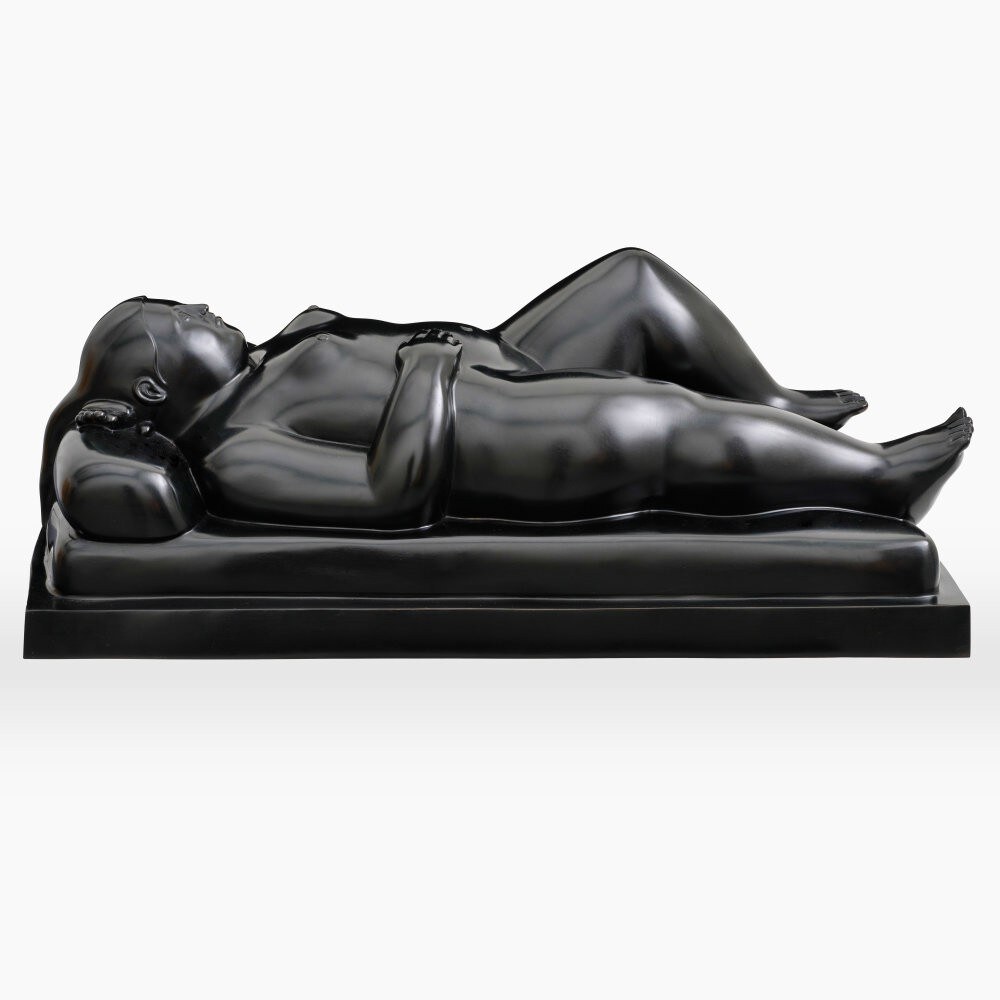
L'introduzione del materasso segna un passaggio di particolare interesse nella riflessione plastica di Fernando Botero, poiché trasferisce la figura femminile entro uno spazio appartenente alla dimensione dell'abitare, trasformando un oggetto d'uso quotidiano in un elemento strutturale della composizione. La superficie imbottita perde qualsiasi funzione accessoria e assume il valore di un dispositivo formale attraverso il quale l'intera costruzione plastica acquista ordine, misura e coesione. La scena domestica si dissolve così nella sua essenza figurativa, lasciando emergere una riflessione sulla capacità della scultura di assimilare oggetti ordinari senza alterarne la dignità monumentale.
Il rapporto fra corpo e materasso costituisce il vero nucleo dell'opera. Le due presenze si sviluppano secondo un principio di reciproca appartenenza che dissolve ogni gerarchia compositiva. Il piano d'appoggio partecipa alla definizione del corpo con la stessa intensità con cui il corpo determina l'identità dello spazio sul quale riposa. La figura estende la propria massa oltre i limiti anatomici, mentre il materasso accoglie tale espansione trasformandosi esso stesso in forma plastica. Si genera così un organismo unitario nel quale la materia sembra propagarsi senza soluzione di continuità, secondo un processo di lenta crescita che coinvolge ogni elemento della composizione.
Questa assimilazione dell'oggetto quotidiano rappresenta uno degli aspetti più raffinati della ricerca boteriana. La tradizione della natura morta e quella della figura umana, frequentemente distinte nella storia dell'arte occidentale, trovano qui un punto d'incontro nel quale le differenze funzionali perdono progressivamente importanza. Il corpo e il materasso condividono la medesima qualità volumetrica, la stessa densità percettiva e un'identica tensione costruttiva. L'interesse dell'artista si concentra sulla possibilità di ricondurre ogni elemento della realtà entro un linguaggio comune, fondato sulla misura delle proporzioni e sulla coerenza della costruzione plastica.
Anche il rapporto con la gravità assume un significato del tutto peculiare. L'appoggio della figura genera una lenta propagazione delle masse che coinvolge l'intera composizione, suggerendo una reciproca partecipazione fra il corpo e la superficie che lo sostiene. Il materasso sembra accogliere il peso senza deformarsi, mentre il corpo acquista una straordinaria stabilità attraverso il contatto con il piano. Questa relazione produce una percezione dello spazio profondamente diversa da quella che caratterizza molte altre figure distese di Botero. L'orizzontalità non coincide semplicemente con una diversa postura, ma diviene una modalità di organizzazione della materia nella quale ogni volume contribuisce alla costruzione di un equilibrio esteso all'intera opera.
La scelta di un elemento domestico introduce inoltre una riflessione sul rapporto fra intimità e permanenza. L'ambiente privato, tradizionalmente associato alla dimensione dell'effimero e della vita quotidiana, viene trasfigurato attraverso il bronzo, materiale che per eccellenza appartiene alla memoria e alla durata. La scultura concentra così due esperienze apparentemente lontane: la familiarità dell'oggetto d'uso e la solennità della materia monumentale. Da questa convergenza nasce una particolare sospensione temporale, nella quale la scena perde ogni riferimento episodico e assume il carattere di un'immagine destinata a permanere oltre la contingenza dell'esperienza.
Il trattamento delle superfici contribuisce in modo decisivo a questa trasformazione. L'andamento morbido del modellato stabilisce una continuità percettiva fra il corpo e il materasso, rendendo quasi indistinguibile il punto nel quale una forma cede il passo all'altra. La luce percorre la patina bronzea accompagnando le variazioni del rilievo con estrema gradualità, fino a costruire una lettura unitaria della composizione nella quale il ritmo delle curvature prevale sulla definizione dei singoli dettagli. L'occhio segue naturalmente il lento fluire della materia, percependo la scultura come un organismo nel quale ogni parte trova il proprio significato soltanto in relazione all'insieme.
In questa prospettiva, Donna distesa su materasso affronta un tema centrale della ricerca di Botero: la possibilità di conferire alla quotidianità una dimensione universale attraverso gli strumenti propri della scultura. L'oggetto domestico viene sottratto alla sua funzione originaria e ricondotto entro un ordine formale che gli attribuisce una nuova identità, fondata esclusivamente sui rapporti plastici. La trasformazione riguarda tanto il corpo quanto lo spazio che lo accoglie, entrambi coinvolti in un processo di progressiva astrazione che conduce l'immagine verso una condizione di assoluta essenzialità.
All'interno della produzione scultorea dell'artista, quest'opera rivela con particolare chiarezza come il linguaggio plastico possa nascere dalla relazione fra elementi appartenenti alla vita più ordinaria senza rinunciare a una forte tensione monumentale. La figura e il materasso condividono una medesima logica costruttiva, dando origine a una sintesi nella quale la forma raggiunge una qualità di sorprendente equilibrio. La memoria dell'esperienza quotidiana rimane così custodita entro una costruzione che appartiene ormai al tempo lungo della scultura, dove materia, spazio e percezione convergono in un'unica, compiuta architettura plastica.
The introduction of the mattress marks a particularly significant development in Fernando Botero's sculptural inquiry, as it relocates the reclining female figure within the sphere of dwelling, transforming an object of everyday use into an integral component of the sculptural structure. The upholstered surface relinquishes its merely functional identity and assumes the role of a formal device through which the composition acquires order, proportion, and internal coherence. The domestic setting is consequently distilled to its essential visual condition, allowing a more profound meditation to emerge on sculpture's capacity to absorb ordinary objects into its own language while preserving the monumental dignity that characterises Botero's plastic imagination.
The relationship established between the body and the mattress constitutes the conceptual nucleus of the work. Rather than existing as independent entities, both elements develop according to a principle of reciprocal belonging that dissolves any hierarchical distinction within the composition. The supporting plane contributes to the definition of the figure with the same intensity through which the body determines the identity of the space it occupies. The corporeal mass extends beyond its anatomical limits, while the mattress receives and prolongs that expansion until it acquires the same sculptural status as the figure itself. What emerges is a unified plastic organism in which matter appears to propagate continuously from one element to the other, following a process of gradual growth that encompasses the composition in its entirety.
Such assimilation of the everyday object represents one of the most sophisticated achievements of Botero's sculptural language. Traditions that Western art has historically maintained as distinct—the representation of the human figure and that of the inanimate object—are brought into convergence through a common formal vocabulary, where functional differences gradually yield to shared plastic values. Body and mattress possess the same volumetric consistency, the same perceptual density, and an identical constructive discipline. The sculptural investigation thus extends beyond the figure itself, embracing the possibility of translating every component of reality into a unified visual language governed by proportion, equilibrium, and structural coherence.
Within this context, gravity assumes a role that extends well beyond its physical dimension. The reclining body generates a gradual diffusion of mass that embraces the entire composition, suggesting a reciprocal participation between figure and supporting surface. The mattress receives weight without recording its effects descriptively, while the body acquires its extraordinary stability through contact with the horizontal plane. Their relationship establishes a spatial condition fundamentally different from that encountered in many of Botero's other reclining figures. Horizontality becomes a principle of formal organisation through which every volume contributes to an equilibrium that encompasses the work as a whole, transforming physical support into an active component of sculptural construction.
The presence of a domestic object also introduces a subtle reflection on the relationship between intimacy and permanence. The private sphere, traditionally associated with the transience of everyday life, is here translated into bronze, a material historically identified with durability and memory. The sculpture thus brings together two apparently distant dimensions: the familiarity of the ordinary object and the timeless authority of monumental material. Their convergence produces a distinctive suspension of time, through which the represented scene is released from the contingencies of lived experience and assumes the enduring condition of an image shaped for permanence.
The treatment of the surface contributes decisively to this transformation. The gentle progression of the modelling establishes a perceptual continuity between the body and the mattress, rendering almost imperceptible the threshold at which one form yields to the other. Light moves across the bronze patina with measured continuity, accompanying each variation of relief and constructing a unified reading of the composition in which the rhythm of curvature prevails over the definition of individual details. The eye follows the gradual movement of matter with complete naturalness, perceiving the sculpture as an organism whose constituent parts acquire meaning only through their participation in the larger formal whole.
Within this perspective, Woman Laying Down on Mattress addresses one of the central concerns of Botero's artistic investigation: the capacity of sculpture to confer universal significance upon the ordinary through the autonomous language of form. The domestic object is progressively detached from its original function and assimilated into a constructive order that assigns it a new identity founded entirely upon plastic relationships. This transformation embraces both the body and the space that receives it, drawing them into a process of formal synthesis through which the image attains an exceptional degree of essentiality and internal coherence.
Within Botero's sculptural oeuvre, the work offers one of the clearest demonstrations of how sculptural language may arise from the encounter between elements belonging to the most familiar sphere of human experience while preserving an unmistakable sense of monumentality. Figure and mattress participate in the same constructive logic, generating a synthesis in which every component contributes to the equilibrium of the whole. The memory of everyday life is thus preserved within a structure that belongs to the enduring time of sculpture, where matter, space, and perception converge into a single, fully resolved plastic architecture.